Cosmic Exploration Editorial Department: The Balance between the Fun of the Movie and the Miscellaneous Types
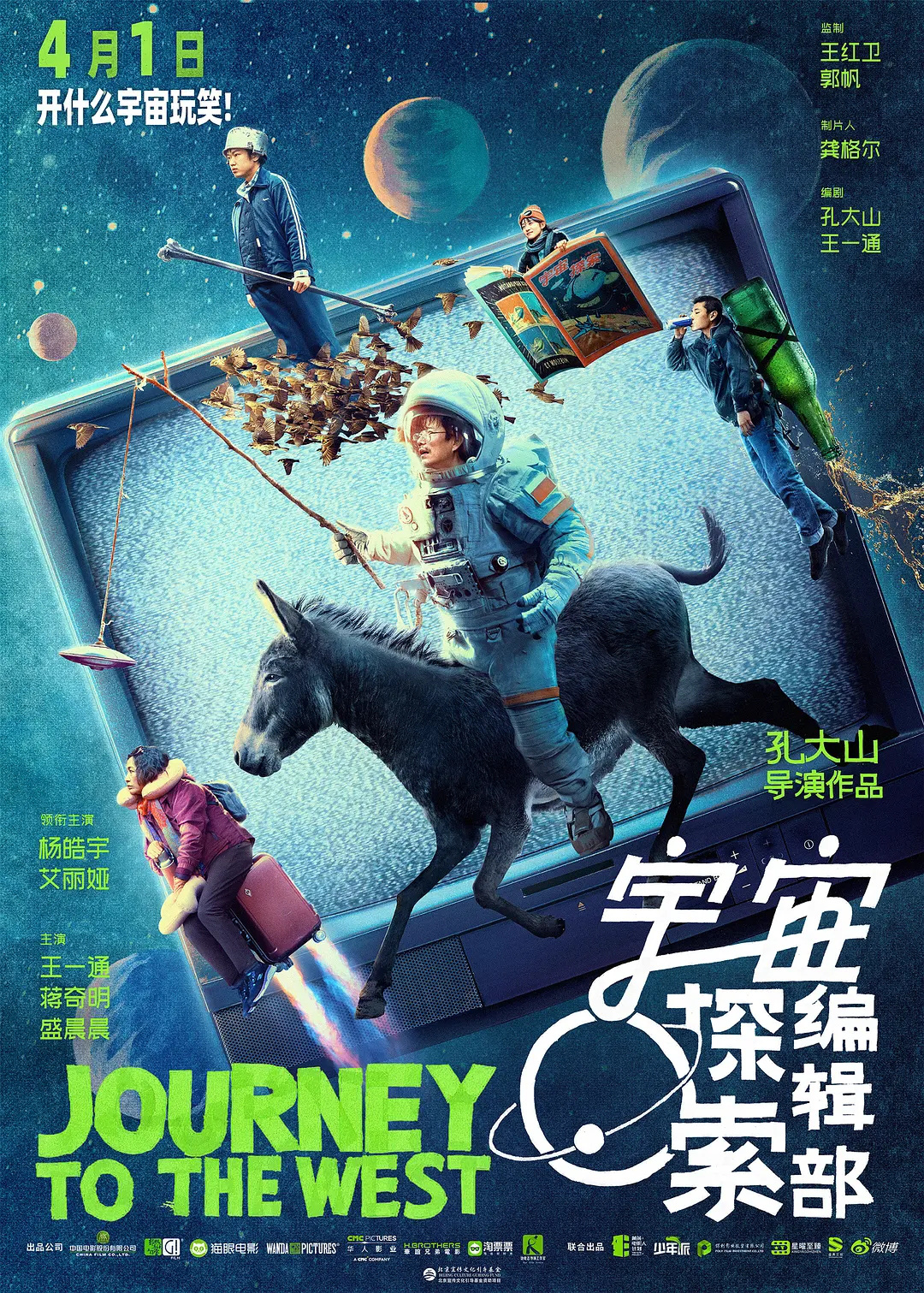
Directed by a young director, won many awards at Pingyao International Film Festival in 2021, which aroused the ardent expectations of fans. On April 1st, the day of the film’s release, fans tried to name the genre, such as rural absurd road film or mockumentary folk soft science fiction, but it seemed difficult to determine the genre boundary accurately. However, the audience in the cinema repeatedly applauded the absurd and unexpected jokes, which is enough to see that the Cosmic Exploration Editorial Department has reached a secret balance between the mixture of genre elements and personal expression.
The creative path of young director Kong Dashan is reminiscent of the creative process experienced by young directors in France, and through the accumulation of short film creation and the nourishment of fans’ interest, the "new wave" opened by such classic works has been achieved. Looking back at the creative pedigree of director Kong Dashan, this film, as its first feature film Virgo, combines the visual presentations of short films such as The Future of the Legal System, The Trouble of Young Maliao, and The Teachers Left in Spring, which were popular on the Internet. Mockumentary’s narrative perspective, Aki Cauris’s Machiavelli’s scene scheduling, the marginal characters in the film and the unexpected poetry generated by the superposition of the film’s nonsense dialogue all expand the multi-dimensional orientation of the film, and also establish the director’s highly recognizable image style and narrative rhythm in his creation. The collage banners in the editorial department of Cosmic Exploration, pink Hello kitty humidifier, lonely marginal teenagers and stone lions as symbols, Kong Dashan sometimes parodies and sometimes deconstructs in his limited sequence of works, in order to achieve the author’s film-like self-reference.
Earthy sci-fi, absurd comedy, low-cost road films and typical author films, the creators can not only integrate these seemingly unrelated or even contradictory elements, but also attract the audience to laugh constantly through one ridiculous and hilarious plot. In addition to the imaginative power, the unique narrative strategy and accurate visual language contributed to the film "Cosmic Exploration Editorial Department".
The film advances the plot with a combination of five chapters: UFO chaser, difficult road, teenager waiting for sparrow arrival, deep southwest and final chapter: endless road, which seems to be a simple linear narrative with practical social issues. The alien model in the country freezer and the statue in the open space at the foot of the mountain are seemingly absurd images in the real situation, which respond to the reality with strong visual expression. In the spatial movement from Beijing, Chengdu, Niaoshaowo Village to the depths of Liangshan, all kinds of information are sharply and accurately integrated, showing the mental process of five struggling characters gradually converging but separately discrete, and the mythical core of science fiction films is connected in series with the type elements of road films.
Mockumentary-style lens language is not an expedient measure for low-cost production, and it is by no means a youthful debut. The Space Exploration Editorial Department uses the mockumentary-style perspective of holding a lens to smoothly embed the seemingly absurd hypothetical situation of "looking for aliens" in Beijing in 2020 in the first two chapters, thus stably constructing the basic narrative logic of the film. In the opening montage, the video of the protagonist Tang Zhijun interviewed by TV in 1990 and the embarrassing situation of the editorial department of "Cosmic Exploration" seeking advertising sponsorship in 2020 are presented alternately. The low-pixel video footage and the rough image of the hand-held lens visually show the changes of time and space for the audience area. Cross-montage narrative clues interweave the theme of "looking for aliens" with the unremitting pursuit of the protagonist Tang Zhijun for 30 years, effectively establishing the behavioral motives of the characters. The basic law of hiding the camera’s viewpoint in feature films has also been completely overturned. mockumentary established another angle of attention for the audience to look at the screen. The camera leads the audience’s viewpoint by staring at the characters, and the audience follows the protagonist’s journey and sees his "inner monologue" from the perspective of dual viewing. When the characters face the camera, they are stiff, redundant and embarrassed, and they casually glance at the camera, so they use the way of jumping and cutting a lot, which runs counter to the expectation that most viewers use long lenses to construct realistic viewing. Tang ZhijunThe two scenes of reading the daughter’s short message in the mobile phone are presented with documentary non-narrative lens, but when this short message asking about the ultimate meaning of human existence in the universe is read, the audience will immediately realize the emotional power contained in the previous two narrative "empty mirrors". And this short message is the core theme that this film wants to convey: the exploration of extraterrestrial civilization by human beings is actually to put human beings in a time and space that they have never reached before, and to reflect on their own situation.
After mockumentary’s lens language completed the narrative function, the camera’s viewpoint changed immediately. "The boy waiting for the sparrow arrival" is the most poetic passage in this film. The "alien myth" that the villagers passed down from mouth to mouth beyond recognition seems to be a lonely teenager with crazy words but like a "prophet". The quiet space built by muddy ridges and scattered villages has delayed the journey of "looking for UFOs". At this time, the lens language is very different from the previous two chapters. The long lens and the empty mirror make the visual rhythm slow, and the narrative suddenly broadens, like a literati painting that suddenly opens a spare pen, and promotes the narrative in romantic poetry with actual sound in the rain and mountain breeze. The characters are no longer facing the camera in a cramped environment, and the scenery has expanded to a deeper and wider place. Whether it is Xue Huadian, who is called "the afterglow of the birth of the universe" on the TV in the depths of the indoor scenery, or a stone lion full of sparrows in the outdoor yard, they have reached a visual and psychological "Peach Blossom Garden" together. Based on this, from Tang Zhijun’s decision to go up the mountain alone, the stubbornness of riding a donkey, the spectacle of witnessing the departure of "aliens" to the knot that was finally relieved, the precise visual language and ingenious narrative were delayed, and a seemingly bizarre story was told step by step. Romantic and poetic, rough and true, in business and literature,Clever and mixed type elements and highly recognizable author style have reached a delicate balance. (Author: Guo Mei, lecturer of northwest university of politics and law School of Journalism and Communication)