Leading indicators show that the overall economic recovery in China is obvious.

  Xinhua News Agency, Beijing, March 31st Question: The leading indicators show that the overall economic recovery in China is obvious.

  Xinhua News Agency reporters Zhou Wenqi, Xin Guo and Zhang Wenjing.

  According to the latest data, the purchasing managers’ index (PMI) of China’s manufacturing industry was in the expansion range for the third consecutive month in March.

  According to the data released by the Service Industry Research Center of the National Bureau of Statistics of China and China Federation of Logistics and Purchasing on the 31st, the purchasing managers’ index (PMI) of manufacturing industry was 51.9% in March, which was 0.7 percentage points lower than that of the previous month and higher than the critical point, and the manufacturing industry kept expanding.

  "Affected by factors such as the high base last month, the manufacturing PMI declined in March, and the prosperity level was still the highest in the past two years. Among the 21 industries surveyed, 13 industries had higher PMI than last month." Zhao Qinghe, senior statistician of the Service Industry Research Center of the National Bureau of Statistics, said.
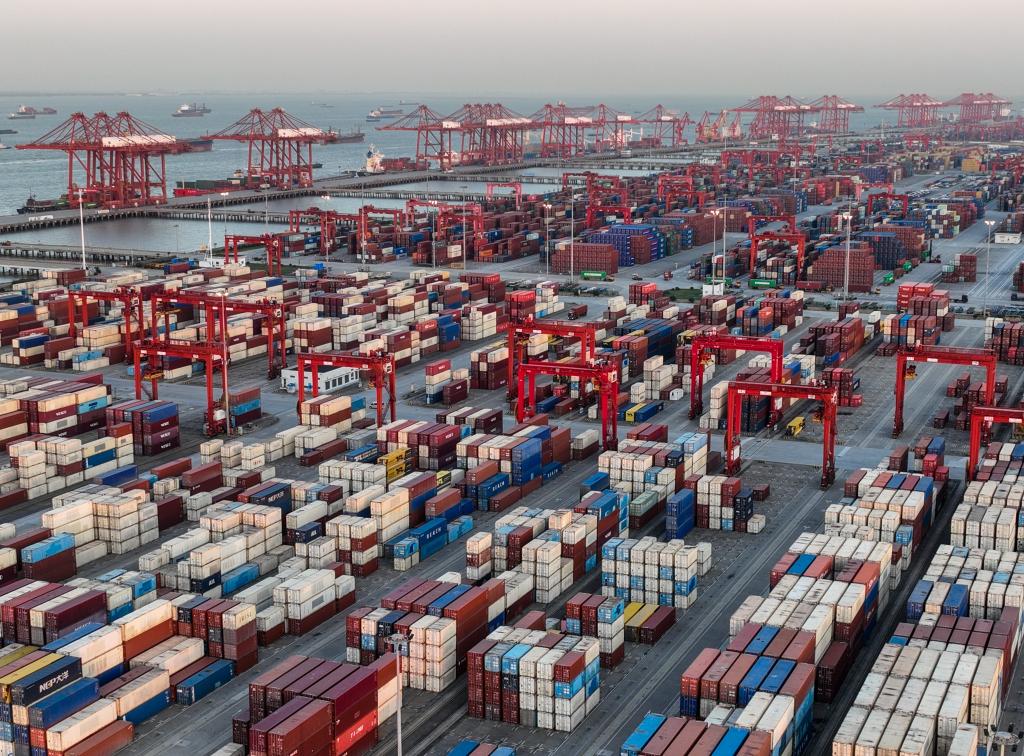
  This is the wharf of Taicang Port in Jiangsu Province (photo of drone) taken on March 13th, 2023. Xinhua News Agency reporter Li Boshe

  From October to December, 2022, China’s manufacturing PMI was 49.2%, 48% and 47% respectively, and it was in the contraction range for three consecutive months. In January 2023, it jumped to 50.1% and returned to the expansion range. In February, it climbed to 52.6%.

  Zhang Liqun, a researcher at the the State Council Development Research Center, said that since October last year, the manufacturing PMI has relatively quickly returned from threshold to the line of prosperity and decline. Although it fell back in March this year compared with February, 51.9% is still at a higher level on the line of prosperity and decline.

  "Although there is a slight fluctuation, the situation that the manufacturing PMI has been on the line of prosperity and decline for three consecutive months shows that the level of economic activity in China has continued to rise, the vitality of business entities has gradually increased, and the overall economic recovery trend is obvious." Zhang Liqun said.

  According to statistics, the PMI of large, medium and small enterprises in March was 53.6%, 50.3% and 50.4% respectively, all above the critical point.

  Zhao Xijun, co-dean of China Capital Market Research Institute of Renmin University of China, said that in the past, sometimes the manufacturing PMI was higher than 50%, but the performance of SMEs was poor. Nowadays, the PMI of large, medium and small enterprises is in the expansion range, indicating that the production and operation of various business entities are steadily recovering.
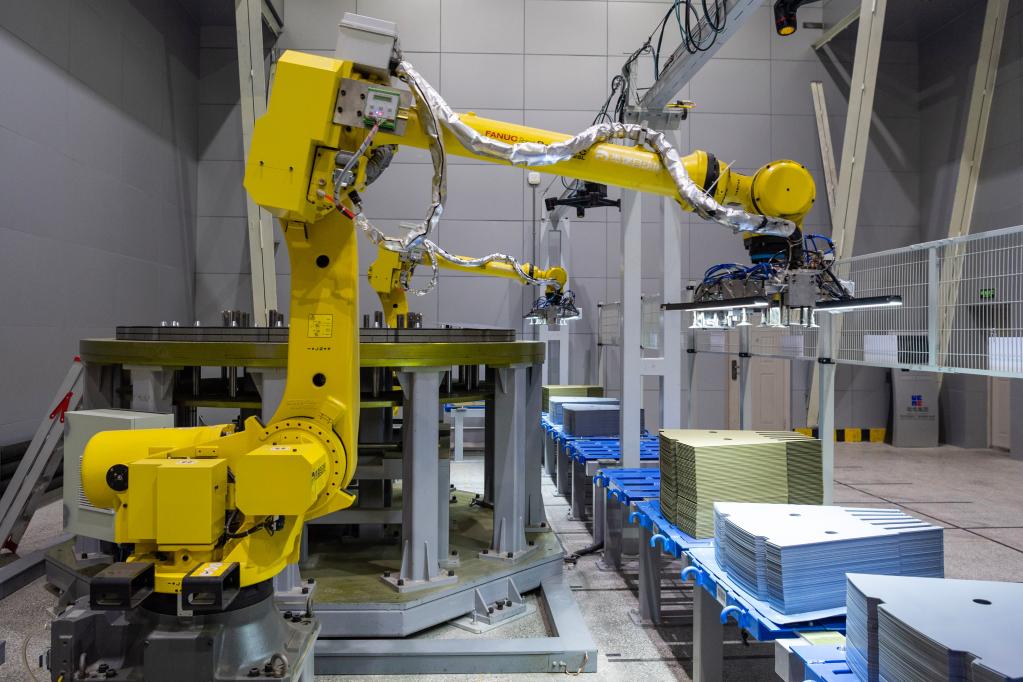
  On March 29th, in the production workshop of Harbin Electric Machinery Factory Co., Ltd. of Harbin Electric Power Group, the intelligent laminating robot was carrying out automatic operation. Xinhua News Agency reporter Xie Jianfei photo

  In addition, the production index in March was 54.6%, and the new order index was 53.6%.

  Zhao Xijun said that these two figures have reached a high level of prosperity, which not only shows that the manufacturing enterprises have increased their production tasks, started well, and the overall market has improved, but also shows that the policy of "stabilizing the economy and expanding domestic demand" is constantly showing results.

  The performance of non-manufacturing industry is even brighter. In March, the business activity index of non-manufacturing industry was 58.2%, up by 1.9 percentage points from the previous month, which was significantly higher than the critical point, indicating that the pace of recovery and development of non-manufacturing industry was accelerated.

  Zhao Qinghe said that from the perspective of industry, the business activity index of retail, railway transportation, road transportation, air transportation, leasing and business services is higher than 60.0%, indicating that residents’ willingness to consume and travel has increased recently, and the market activity of related industries has rebounded rapidly.

  Like the latest manufacturing PMI and non-manufacturing business activity index, many economic indicators released in March all showed an "upward curve", conveying the warmth and vitality of China’s economic recovery.

  In the first two months of this year, the total retail sales of consumer goods in China increased by 3.5% year-on-year. Investment in fixed assets increased by 5.5% year-on-year, 0.4 percentage points faster than the annual growth rate of last year; Total export value increased by 0.9% year-on-year & hellip; … The "troika" driving economic growth is in a steady trend.

  On February 28th, citizens were buying snacks at Sanse Road Night Market in Jinjiang District, Chengdu, Sichuan Province. Xinhua News Agency reporter Tang Wenhao photo

  Qunar. com statistics show that in the first three weeks of March, the number of flight bookings in several cities in China exceeded the same period in 2019; According to the monitoring data of the State Post Bureau, as of March 8, the express delivery business in China reached 20 billion pieces in 2023, 72 days ahead of 2019; According to data released by the People’s Bank of China, the scale of social financing increased by 3.16 trillion yuan in February, 1.95 trillion yuan more than the same period last year … … The activity of people flow, logistics and capital flow has been significantly improved.

  After raising the GDP growth forecast of China in 2023 from 5.2% to 5.5% in January, the investment bank Goldman Sachs recently raised the growth forecast to 6%.

  "The solid material and technical foundation for economic development, the rapid and stable transition of epidemic prevention and control, the appropriate and effective macroeconomic policies, and the increasing confidence of business entities have made China’s economy steadily pick up and continue to improve after the start of the year." Zhang Liqun said that China’s economy has steadily entered the track of recovery, and the prospect of recovery is relatively clear, and it is expected to get out of the economic growth curve of sustained recovery throughout the year.

  In 2023, China’s economic operation started well. Looking forward to the whole year, people in the industry believe that although China’s economic development is still facing pressure and challenges, with the gradual consolidation of the foundation of economic recovery and the continuous implementation of measures to stabilize the economy, it is expected to continue to recover to a good situation throughout the year.

Gather dreams and strength to build a community of Asian destiny

  Xinhua News Agency, Beijing, April 7th Feature: Gathering Dreams and Strength to Build a Community of Asian Destiny

  Xinhua News Agency reporter Sun Ping Lu Jiafei

  The sea is wide and the sails are dancing, and the sky is high and the wind is warm. Five years ago, in Boao, the Chairman of the Supreme Leader called on Asian countries to establish a sense of community of destiny and push the development of Asia and the world to a new level. Three years ago, the Chairman of the Supreme Leader elaborated on the concept of a community of Asian destiny in Boao and drew a blueprint for a new future in Asia.

  The 2018 annual meeting of Boao Forum for Asia is about to open. Comply with the general trend of Asian development and gather Asian development forces. China played a symphony of destiny with Asian countries, and the community of destiny gradually became the "Asian Consensus".

  Sharing concept

  Drinking the same river, fate is closely linked. The Lancang-Mekong River, which stretches across Wan Li, has witnessed the beautiful picture that China initiated and established a new sub-regional cooperation platform with Thailand, Cambodia, Myanmar, Laos and Vietnam to build a community of destiny.

  In just two years, the Lancang-Mekong cooperation mechanism has become the first version of the Asian destiny community. The pattern of "leaders leading, all-round coverage and participation of all departments", the speed of "making progress every day, making achievements every month and stepping up every year" and the culture of "treating each other as equals, sincerely helping each other and being like a family" all reflect the belief and pursuit of the six countries to deepen the integration of interests and achieve common development, and also demonstrate China’s role as a leader of regional cooperation and a watcher of regional peace and development.

  China practices the neighboring diplomatic concept of sincerity and tolerance, insists on being a good neighbor and partner, deepens friendly cooperation with neighboring countries, actively participates in multilateral cooperation mechanisms in Asia, promotes regional cooperation to blossom and form synergy, and lays the foundation for building a community of Asian destiny.

  China-ASEAN Destiny Community, China-Pakistan Destiny Community, China-Kazakhstan Destiny Community and China-Laos Destiny Community … … The concept of community of destiny has taken root in Asia, and different levels of community of destiny complement each other.

  Bambang Suryono, chairman of the Asian Innovation Research Center, an Indonesian think tank, believes that China’s proposal of a community of Asian destiny provides an ideological guarantee and theoretical basis for common development, peaceful coexistence and mutual benefit in the Asian region. The community of Asian destiny is rooted in China’s "harmony" culture, conforms to the traditional cultural values of Asian countries, and is deeply recognized and supported by Asian countries. Asian countries are increasingly accepting the concept of the community of destiny.

  As the main driving force of the world economy, Asia is also facing challenges such as insufficient growth momentum and integration momentum. China, which has entered a new era, will continue to provide growth momentum for Asia and the world, deepen mutually beneficial cooperation with neighboring countries and further promote the building of a community of human destiny.

  As Salman Ali Bettaney, a professor at the School of Politics and International Relations of Jinnah University, said, building a community of destiny is conducive to enhancing trust among Asian countries and strengthening mutual cooperation and cultural exchanges.

  Build a dream

  Across Qian Shan, build a dream space together. China-Pakistan Economic Corridor, China-Laos Railway, China-Thailand Railway, Anglian-Papu Railway Tunnel, Vietnam Longjiang Industrial Park, Laos Saiseta Industrial Development Zone, Cambodia Sihanoukville Special Economic Zone, Sri Lanka Hambantota Port … … China and Asian countries discuss and share the "Belt and Road" and build a community of Asian destiny with practical actions.

  Asia is the first region of the Belt and Road Initiative. Five years ago, China initiated the "Silk Road Economic Belt" and the "21st Century Maritime Silk Road" in Kazakhstan and Indonesia respectively, which were warmly responded by Asian countries. In January 2016, the Asian Infrastructure Investment Bank was officially put into operation. So far, it has provided financial support for development projects in many Asian countries, including the expressway project in Pakistan, the subway project in Bangalore, India, the energy project in Myanmar, the slum upgrading project in Indonesia, and the fiber-optic broadband network construction in Oman.

  The construction of the "Belt and Road" in Asia has changed the infrastructure of many countries, created a land-sea connectivity map, and stimulated local investment and industrial development.

  Hu Yishan, chief consultant of the Malaysian Pacific Research Center, believes that the community of Asian destiny focuses on promoting economic, trade and economic development. There are still many countries and regions in Asia with backward infrastructure. The Belt and Road Initiative and the AIIB can help regions improve their infrastructure and boost regional economic development.

  A trickle merges into the sea, and a little starlight illuminates the Milky Way. The "Belt and Road" brings together the dreams of people in Asian countries and connects the development strategies of various countries.

  Cambodian Prime Minister Hun Sen said that the "Belt and Road Initiative" fits well with Cambodia’s national development plan. Bangladeshi Prime Minister Hasina said that Bangladesh is willing to strengthen cooperation with China in the process of realizing the dream of "Golden Bangladesh".

  Suryono believes that the "Belt and Road" construction is conducive to integrating the resources of Asian countries, giving full play to their comparative advantages, and achieving common development and prosperity in Asia. The construction of the "Belt and Road" attaches importance to the communication between the people, which is also conducive to enhancing mutual trust and understanding among Asian countries, reducing ethnic, religious and cultural conflicts, and laying the foundation for building a community of Asian destiny.

  Draw a blueprint together

  As close as lips and teeth, share weal and woe. To build a community of Asian destiny, common security is essential. At present, Asia is facing traditional and non-traditional, internal and external security challenges, and regional hot spots come one after another. Countries outside the region intervene in regional security affairs, and the game of great powers around geopolitics intensifies. The common will of Asian countries to pursue peace and development calls for a new Asian security concept.

  At the AsiaInfo Shanghai Summit in 2014, the Chairman of the Supreme Leader put forward the Asian security concept of "common, comprehensive, cooperative and sustainable". In his speech at the opening ceremony of the fifth CICA Foreign Ministers’ Meeting in 2016, the Chairman of the Supreme Leader proposed to promote the construction of a security governance model with Asian characteristics.

  Suryono believes that the western security concept pursues absolute security and puts its own security above that of others. China’s concept of Asian security pursues common security, and only when everyone feels safe can it be truly safe.

  Rod Capnan, a columnist of Philippine Standard, believes that China pursues "win-win" and is committed to sharing the dividends brought by its reform and development with other countries in the world. China has done the same, including promoting the building of a community of Asian destiny and launching the "Belt and Road Initiative".

  Building a universal and safe Asian security system requires enhancing mutual trust among countries, and enhancing mutual trust is inseparable from cultural exchanges and mutual learning among civilizations within the Asian family.

  At the 2015 annual meeting of the Boao Forum for Asia, the Chairman of the Supreme Leader proposed to hold a conference on dialogue of Asian civilizations, strengthen exchanges between young people, non-governmental organizations, local governments, media and other sectors, and build a think tank exchange and cooperation network, so that Asian people can enjoy a richer spiritual life and make regional development cooperation more dynamic. The 2016 Annual Meeting of Boao Forum for Asia held the Dialogue of Asian Civilizations. On the theme of "Colorful Civilization and New Vitality in Asia", representatives from China, Pakistan, Iran, Singapore and UNESCO started a dialogue.

  China is good, and Asia can be good; If Asia is good, China will be better. China and Asian countries have joined hands on the journey of building a community of destiny and jointly painted a beautiful picture of a new Asia. (Participating in reporters: Liang Hui, Ji Wei, Liu Tong, Zhang Dacheng, Yuan Mengchen, Dong Chengwen, Wang Yu, Zhang Jianhua)