What is the reliable way to bid farewell to the debt of gratitude when high human consumption becomes rural vulgarity?
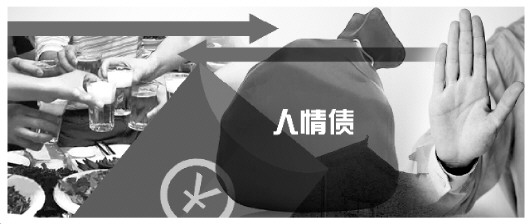
Cartography/Gao Yue
Our reporter Chen Lei
Intern Chen Jiayun of our newspaper
Marrying a daughter-in-law, marrying a daughter, the death of an elderly person, building a house, moving a house, opening a shop, entering a university, joining the army, giving birth to a child, having a child at the age of 10, and having an adult at the age of 36 are all names for farmers to hold banquets.
In some rural areas of our country, human customs are alienated, projects increase sharply, and gift money soars. Some farmers borrow money to give away their feelings, which affects their production and life, and "good customs go to bad customs".
Recently released "No.1 Document of the Central Committee" in 2017 — — "Several Opinions of the Central Committee of the Communist Party of China and the State Council on Deepening the Structural Reform of Agricultural Supply Side and Accelerating the Cultivation of New Kinetic Energy for Agricultural and Rural Development" proposes to strengthen the work of changing customs in rural areas and guide the masses to resist stereotypes and bad habits such as weddings, funerals, weddings, and debt of gratitude.
Experts interviewed by the reporter of "Legal Daily" believe that on the one hand, stereotypes and bad habits such as weddings, funerals, weddings, lavish activities and debt of gratitude can be guided by village rules and regulations; On the other hand, party member’s cadres and public officials are prohibited from doing big things through legislation, so as to promote rural customs.
Social customs are deteriorating.
In recent years, China Rural Governance Research Center of Huazhong University of Science and Technology has been organizing teachers and graduate students to return home for investigation during the Spring Festival. In more than 10 provinces such as Central China and Northeast China, nearly 100 post-80 s and post-90 s researchers have set their sights on their hometowns.
In an ordinary agricultural village in northern Anhui, the per capita arable land is 1.5 mu, and the older generation stays behind to farm, mainly planting food crops such as wheat and rice. Young and middle-aged people go out to work, and working has become the main source of income for many families.
Three years ago, the standard for villagers who belong to the same natural village and have a general relationship was 50 yuan or 60 yuan, while the nearest neighbors and friends were generally in 100 yuan, and the nearest brothers and sisters were 500 yuan or 600 yuan.
In the past three years, this standard has generally doubled, and villagers with ordinary relations have been carried to 100 yuan, and their closest brothers and sisters have reached more than 1000 yuan.
Gui Hua, an associate researcher at China Rural Governance Research Center of Huazhong University of Science and Technology, sorted out the names of banquets hosted by farmers in Zigui, Hubei Province. After 2000, human customs began to change, especially in the last five or six years. Nowadays, the names of banquets hosted by farmers in Zigui generally include: marrying a daughter, marrying a daughter, the death of the elderly, building a house, selling a house and moving, opening a shop, entering a university, joining the army, having children, children reaching the age of 10, adults reaching the age of 36, and so on, with more than ten items.
According to media reports, in Wuxi County, Chongqing, a typical mountainous county and a national key poverty alleviation and development county, there is a "comfort wine" for failing in the college entrance examination, a "reformed wine" for returning home from prison, and a "baby-protecting wine" for children before they are born. Even sows have to drink the whole wine when they give birth.
Guihua believes that human feelings have existed since ancient times, and it is the basic means to maintain social life in a relatively static traditional rural society. Farmers transmit their feelings through human interaction, thus building a stable social relationship and meeting the daily mutual needs of farmers.
"Folklore is a social activity and a product of society. It has strong spontaneity and sociality." Guihua told the reporter of Legal Daily that great changes have taken place in rural social life since the reform and opening up more than 30 years ago. Many long-standing folk customs have been "alienated" under the current social background of great changes, and the growing popularity of human banquets in many areas is one example.
"We have seen in the national survey that farmers in some places are competing to hold banquets, and human feelings have even become a means of collecting money, and social customs have deteriorated." Guihua said, "Good customs go to bad customs."
Zhi Zhenfeng, an associate researcher at the Institute of Law of the Chinese Academy of Social Sciences, told the reporter of the Legal Daily that in recent years, there has been a phenomenon of weddings, funerals and weddings in rural areas, and even a big banquet was held under various pretexts to compare with each other, resulting in bad customs and bad habits. The vicious circle continues, leading to worse and worse rural customs and great harm.
There is no winner in front of human consumption.
All kinds of birthday banquets, such as full moon, centenary, first birthday, birthday, junior high school, high school, university and other "happy events" such as buying a house and a car, have made rural residents overwhelmed by the rising cost of living.
A survey by Guihua and others in Zigui, Hubei Province shows that about one third of farmers’ household income is used for human expenditure, and some families even reach half.
According to media reports, in a village in Wuxi County, in 2016, more than 100 banquets were held in the village, and the villagers gave gifts of 10,000 to 20,000 yuan a year, and even 40,000 to 50,000 yuan. The per capita annual income in the village is less than 6000 yuan, and most villagers go out to work. "For the sake of human feelings, some villagers even gave away their pension insurance money."
The Qinghai Investigation Corps of the National Bureau of Statistics conducted a sample survey on the "human expenditure" of rural residents in Qinghai, and found that the average annual growth rate of "human expenditure" was 12 percentage points higher than the average annual net income growth rate of people.
In the face of debt of gratitude, every family has become a loser.
Guihua explained that human feelings themselves are consumptive. On the surface, it seems that you come and go in balance. But in fact, every human activity requires banquet expenses. The more frequent human activities, the more banquet expenses. In the end, a lot of farmers’ income is consumed by catering.
"In the end, either those with less income can’t afford to play ‘ Friends circle ’ Withdrawing from social activities can only affect family development by sticking to the scalp. " Guihua believes.
Guihua believes that the current changes in human customs stem from two aspects of changes in social life: first, urbanization accelerates population mobility, traditional rural social relations tend to disintegrate, farmers’ daily contacts expand, and "friends circle" has changed; Second, employment opportunities have increased, farmers’ income has become diversified, there has been a certain degree of differentiation within rural society, and money and material factors have played a greater role in interpersonal communication. In this way, there has been a strange phenomenon that it is difficult for farmers to talk about feelings without human feelings.
It is difficult to change customs by simple legal means.
Human relationship was originally a traditional virtue in China, and it was a link to maintain good social relations, but now it has become a bad habit of consumption.
So, how to solve this problem?
In the "No.1 Document of the Central Committee" in 2017, the central government proposed to strengthen the work of changing customs in rural areas and guide the masses to resist stereotypes such as weddings, funerals, weddings, and debt of gratitude.
Zhi Zhenfeng told the reporter of Legal Daily that it is difficult to change customs in rural areas simply through legal means. First, the obstacles in legislative adjustment, "changing customs is not the scope of local legislation authorized by the legislative law."
Zhi Zhenfeng said that the second is the obstacle in the implementation of the law. "Many rural customs, even some bad habits, are part of the whole rural social environment. The social environment does not change, and it is very difficult to get rid of bad habits only by means of legal prohibition. After all, this is a voluntary behavior of the villagers and does not violate the mandatory laws and regulations of our country. "
Guihua told the "Legal Daily" reporter that rural weddings, funerals, weddings, lavish activities, debt of gratitude and other stereotypes have not violated or violated any national laws, but are a social activity, which is difficult to be bound by the mandatory provisions of the law.
Zhi Zhenfeng believes that what can be done to change rural customs and get rid of bad habits is to strictly implement the Party’s internal laws and regulations, strictly manage the Party in an all-round way, and at the same time, amend the relevant laws and regulations of state civil servants, clarify the professional ethics of public servants, and prohibit party member cadres and public officials from throwing banquets, receiving big gifts, eating and drinking, so as to drive the change of the rural stereotypes and bad habits.
Experts interviewed by reporters all believe that the government can also guide the masses to resist stereotypes such as weddings, funerals, weddings, and debt of gratitude through village rules and regulations.
Guihua said that social customs are a tradition, and the appearance of stereotypes and bad habits is essentially the disintegration of norms under the traditional lifestyle. Moreover, once the social order is out of order, it is difficult to spontaneously evolve in a benign direction. At this time, intervention from external forces, such as government intervention, is needed to help form good social customs.
How should government departments intervene?
Guihua believes that a better way is for the government departments to issue some initiative documents for the problems strongly reflected by the people, such as some initiative documents to change customs and habits in the construction of beautiful rural areas, and clarify the standards of public order and good customs.
"After the publication of the document, it is not the government departments that use administrative means to enforce it, but to encourage and guide farmers to formulate village rules and regulations that conform to the village conditions and people’s feelings by means of villagers’ autonomy, and to form a set of new customs and standards that are suitable for farmers’ needs and adapt to local social and economic life." Guihua said that only the norms formed by farmers’ participation can be recognized and consciously observed by farmers.
Zhi Zhenfeng said that in addition to national legislation, government departments can be guided by township regulations or village regulations to rebuild rural communities and get rid of bad habits.
"It is necessary to pass ‘ Hard method ’ It is also necessary to ban the stereotypes and bad habits of cadres and public officials in party member through ‘ Soft method ’ Guide the masses to resist stereotypes and bad habits, and both will form a good public morality and a benign social atmosphere. " Zhi Zhenfeng said.